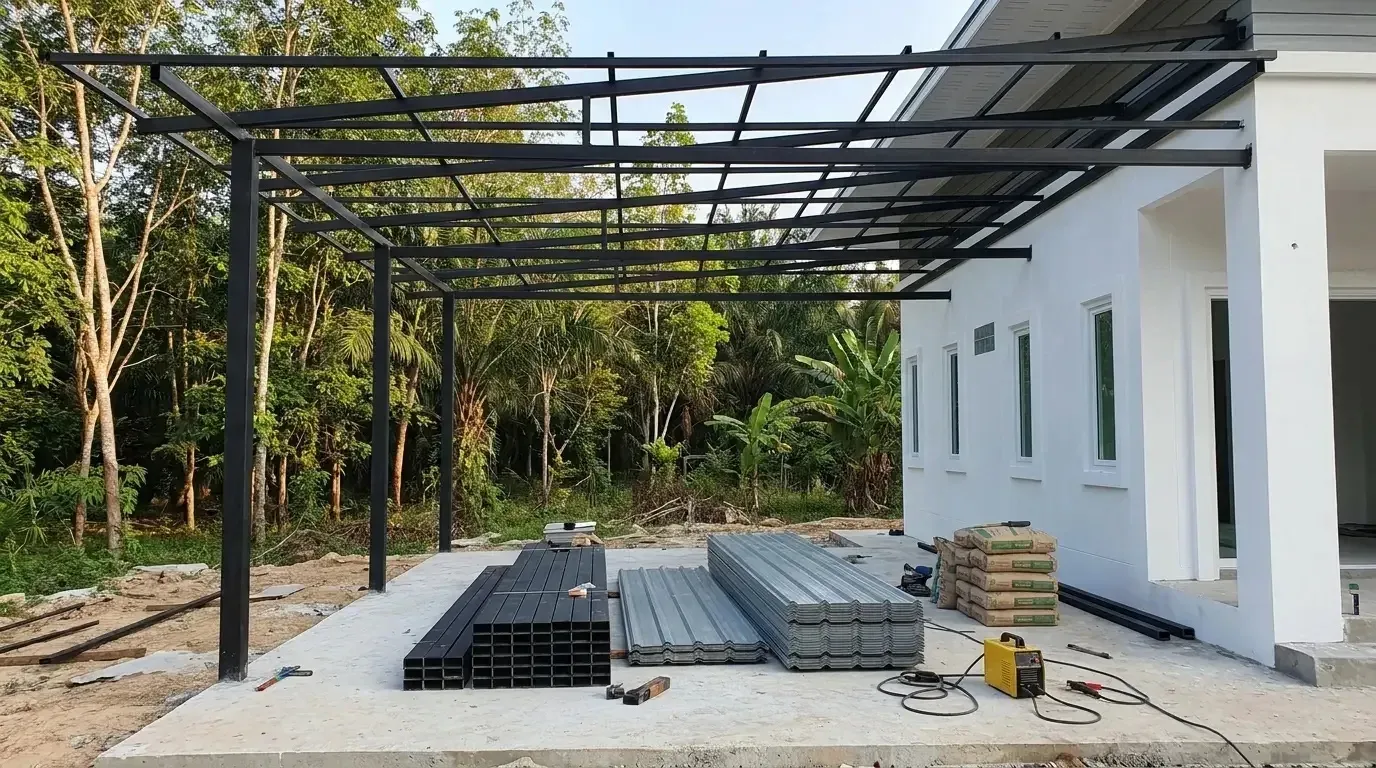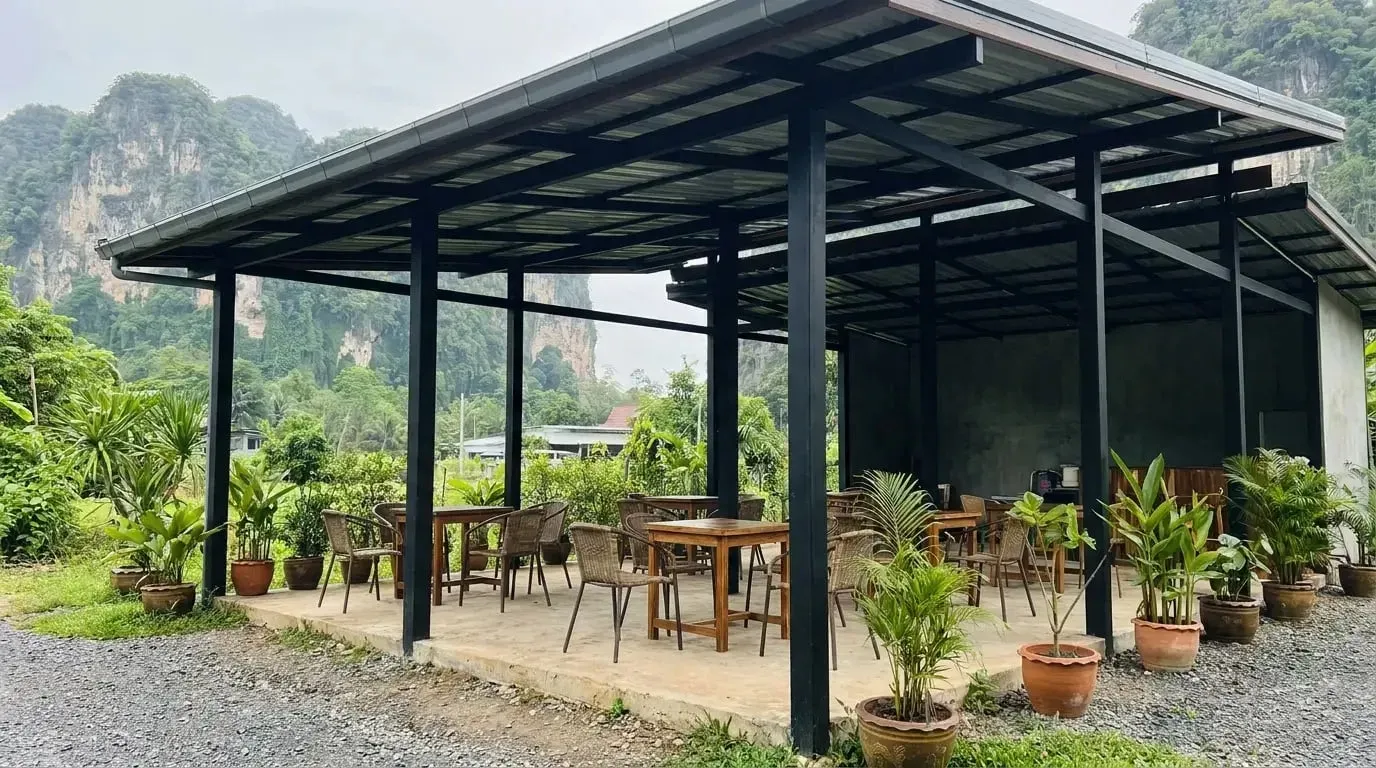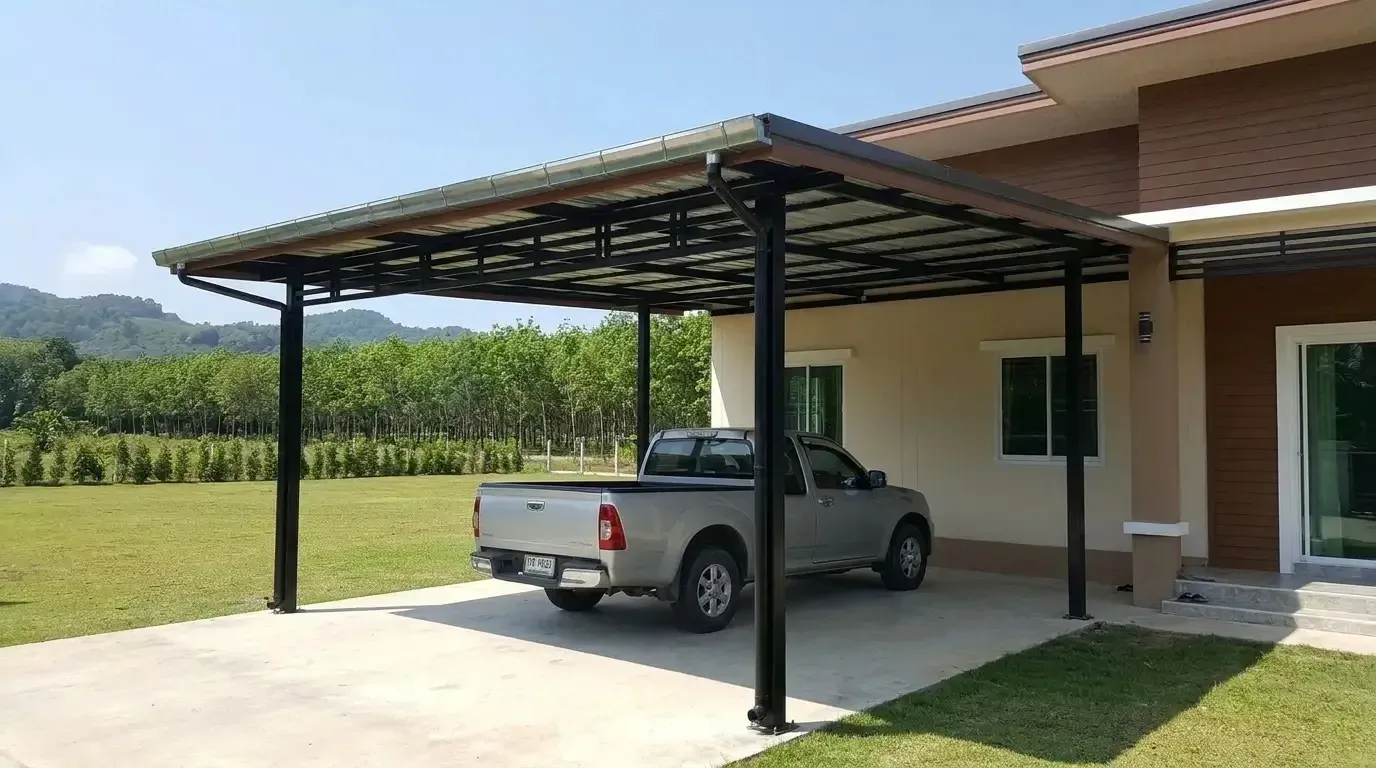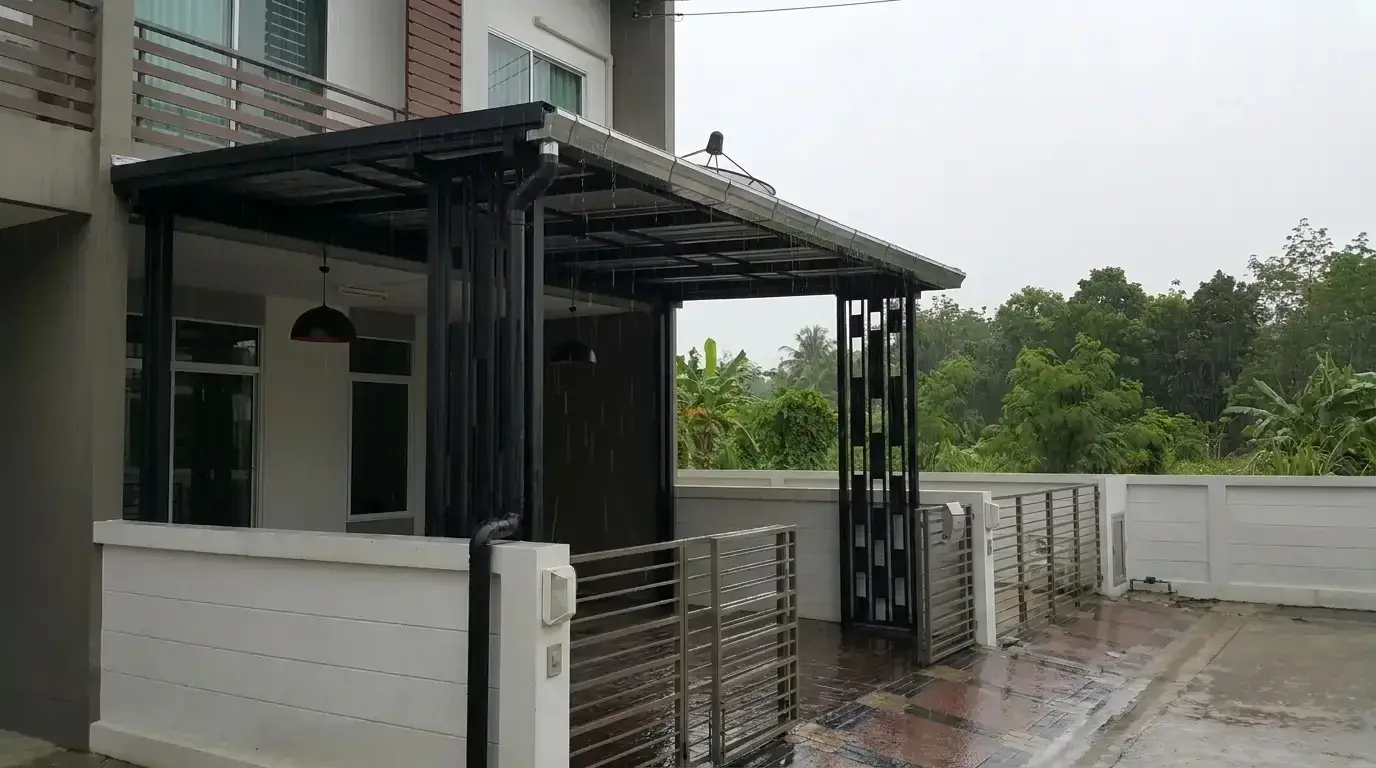
Anyone who has spent a rainy season on the Andaman coast knows the rain here is not a light drizzle. From roughly May to October, storms can drop a lot of water in a short time, often with wind. A roof extension that looks fine in March can show every weakness by July: a drip at the wall, a gutter spilling over, a puddle where the posts meet the ground.
This article covers the four things that decide whether a new awning, carport or covered walkway copes: slope, gutters, flashing and timing.
Slope: let the water leave quickly
Why slope matters
Water on a roof needs to run off before it builds up. A steeper slope drains faster, carries leaves away and makes it harder for wind to push rain back up under the laps between sheets.
Many homeowners want a flat-looking roof so the extension sits neatly under a window or eave. That is understandable, but every sheet type has a minimum slope set by its manufacturer, and going below it is asking for leaks.
The height problem
The slope is limited by two heights: where the roof meets the house, and the lowest edge you can accept. If the fixing point under your eave is low, there may not be much room. Options include:
- Fixing higher on the wall, if the structure allows
- Choosing a sheet type that tolerates a lower slope
- Reducing the projection so the roof does not need to fall as far
- Sloping the roof away in a different direction
Rong checks these heights at the survey. For shade over doors and windows, see our awning service.
Gutters: size them for real storms
Common gutter mistakes
- Too small. A gutter that copes with normal rain overflows in a Krabi downpour.
- Not enough downpipes. A long gutter with one outlet at the far end fills up before it can drain.
- Flat or backwards fall. Gutters need a slight fall towards the outlet, or water sits in them and they rust or grow algae.
- Nowhere for the water to go. A downpipe that empties onto a path or against the house wall just moves the problem.
Where the water ends up
Before the roof goes up, decide where the water will be discharged: a drain, a soakaway, the garden, or a channel. On sloping sites in areas like Ao Nang this matters even more, because runoff from a large roof can wash soil and gravel away.
Leaf guards and access
If there are trees nearby, plan for cleaning. Leaf guards help, but someone still needs to reach the gutter safely.
Flashing: the joint between new and old
In our experience, the line where the new roof meets the existing house is where extensions most often leak. Here are the essentials.
What flashing does
Flashing is a strip of sheet metal that covers the gap between the new roof and the wall or old roof. It sends water onto the new roof instead of letting it run down behind.
Details that matter
- Tucked into or above the wall line, not just stuck on the surface with sealant
- Enough overlap onto the new roof sheet
- Sealant as a backup, not as the only barrier; sealant hardens and cracks in the sun
- Movement allowed for. Steel expands in the heat; a rigid joint between a steel roof and a masonry wall will open up over time
Joining an existing roof
Tying a new roof into an existing roof, rather than a wall, is more complex. The old roof may be tiles, a different sheet profile, or already tired. Sometimes it is better to renovate the old roof frame at the same time. See roof frame renovation and our general roof service.
Timing your project
Before the rains
The dry months are the easiest time to build. Materials stay dry, the ground is firm for footings, roof sealing cures properly, and there are fewer stoppages. If you know you want an extension, it is worth arranging a survey early.
During the rains
Work can still go ahead, but expect interruptions. Roof sheeting and sealing stop when it is pouring. Footings on soft ground may need extra care. A good contractor will plan the order of work so the site is never left open to the weather at the end of the day.
If something is already leaking
Do not wait for the season to end. A small leak at a joint can wet ceilings and rot timber. A temporary fix may be possible while a proper repair is planned.
Rainy-season checklist for new roof extensions
- Roof slope at or above the minimum for the chosen sheet
- Gutter sized for heavy storms, with enough downpipes
- Gutter falls towards outlets
- Discharge point agreed (drain, soakaway, garden)
- Flashing detailed at the house joint, not just sealant
- Sheet laps facing away from the prevailing wind
- Drill swarf removed from the roof
- Base plates and footings above standing water
- Work schedule with room for rain days
If you are near the coast, rust is the other half of the story. Read stopping rust on steel near the sea.
What it costs
There is no fixed price because slope, gutter length, joint detail and access all vary. Jobs start from 10,000 THB and we quote after a free survey. The awning price guide explains what goes into a typical quote.
Next step
If you are planning an extension, or already have a joint that drips every storm, send photos through LINE on our contact page. A photo taken during rain is especially useful.